Bubble Science
Bubble Science Explained
Surface tension, soap films, evaporation, humidity, wind and why bubbles pop.
A bubble is an extremely thin liquid film held together by surfactant molecules, and everything it does — how big it grows, how long it floats, when it pops — comes down to surface tension, evaporation, airflow and the solution itself. We've spent years making giant bubbles at events, camps and festivals; here's the science in plain English, plus what it means in practice.
What Is a Bubble, and How Does Soap Make It Possible?
A soap bubble is a thin film of water wrapped around air: water in the middle, surfactant molecules lining both outer surfaces, the whole thing often thinner than a wavelength of light.
Plain water can't do this. Surface tension — the inward pull between water molecules — snaps a stretched sheet straight back into a droplet. Surfactants lower that pull just enough for water to spread into a flexible sheet, while leaving enough tension to hold the film together and round a free bubble into a sphere, the shape with the least surface area for the air inside.
That balance is why soaps aren't interchangeable: a detergent that makes great kitchen suds can drain in seconds. A film stretched across a wide giant bubble wand has to stay intact and stay stretchy at once, which is what a purpose-built giant bubble formula is engineered to do.
Why Do Bubbles Pop?
Every bubble thins from the moment it forms, and pops when the thinnest spot can no longer hold.
Evaporation and drainage
Water leaves the film into the air while gravity pulls liquid downward inside it. The film thins — usually fastest at the top — until it can no longer hold.
Physical contact
Grass, gravel, dry hands, hair, dust — anything that isn't wet enough breaks the film instantly.
Wind and turbulence
A gust stretches one part of the film faster than the rest, and it tears where it can't keep up.
Weak or uneven film
An unevenly coated rope or a poorly formulated solution leaves thin patches. Bubbles fail at the thinnest point, not the average one.
Everything you can do to make bubbles bigger and longer-lasting is really about slowing that thinning down.
Weather: Humidity, Temperature and Time of Day
Humidity is the single most useful thing to check. Humid air already holds plenty of water vapor, so it draws water out of the film more slowly — the film stays usable longer and bubbles grow larger. We treat humidity above 30% as a favorable starting point; higher is generally better. Temperature matters mostly through the same mechanism: warm, dry air in direct sun strips water from the film fast, so shade beats full sun on a hot day.
Mornings and evenings aren't inherently better — they're just often humid, calm and cooling. A humid, overcast afternoon is one of the best bubble windows there is, and a dry morning can be miserable. Check the actual humidity and wind, not the clock.
How Wind Affects Giant Bubbles
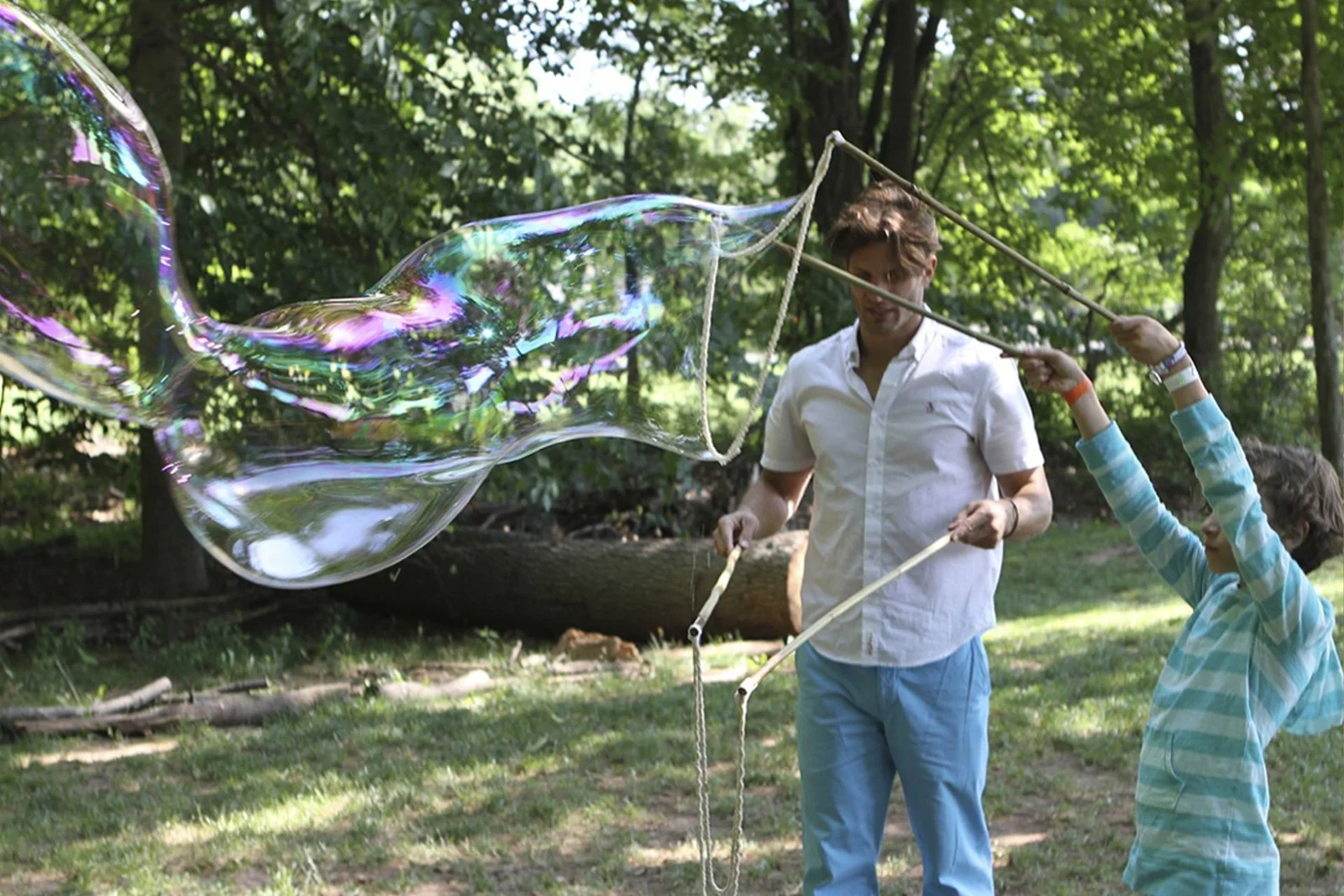
Wind isn't the enemy — it's the engine. You don't blow a giant bubble; moving air pulls the film off the rope and stretches it, so with no airflow nothing happens. Too much, though, stretches the film unevenly, creates weak spots and makes the wand hard to control. Our guideline is wind under about 12 mph. Stand with the wind at your back, and if the air is still, walk slowly backward — the airflow you create does the same job.
What Makes Giant Bubbles Different
A giant bubble asks one large film to survive its own weight, internal drainage and moving air while thinning by the second. Size comes from the wand opening, how evenly the ropes coat, the solution's stretch and drainage resistance, humidity, wind and technique together. A huge wand with weak solution on a dry, gusty day just makes loud pops.
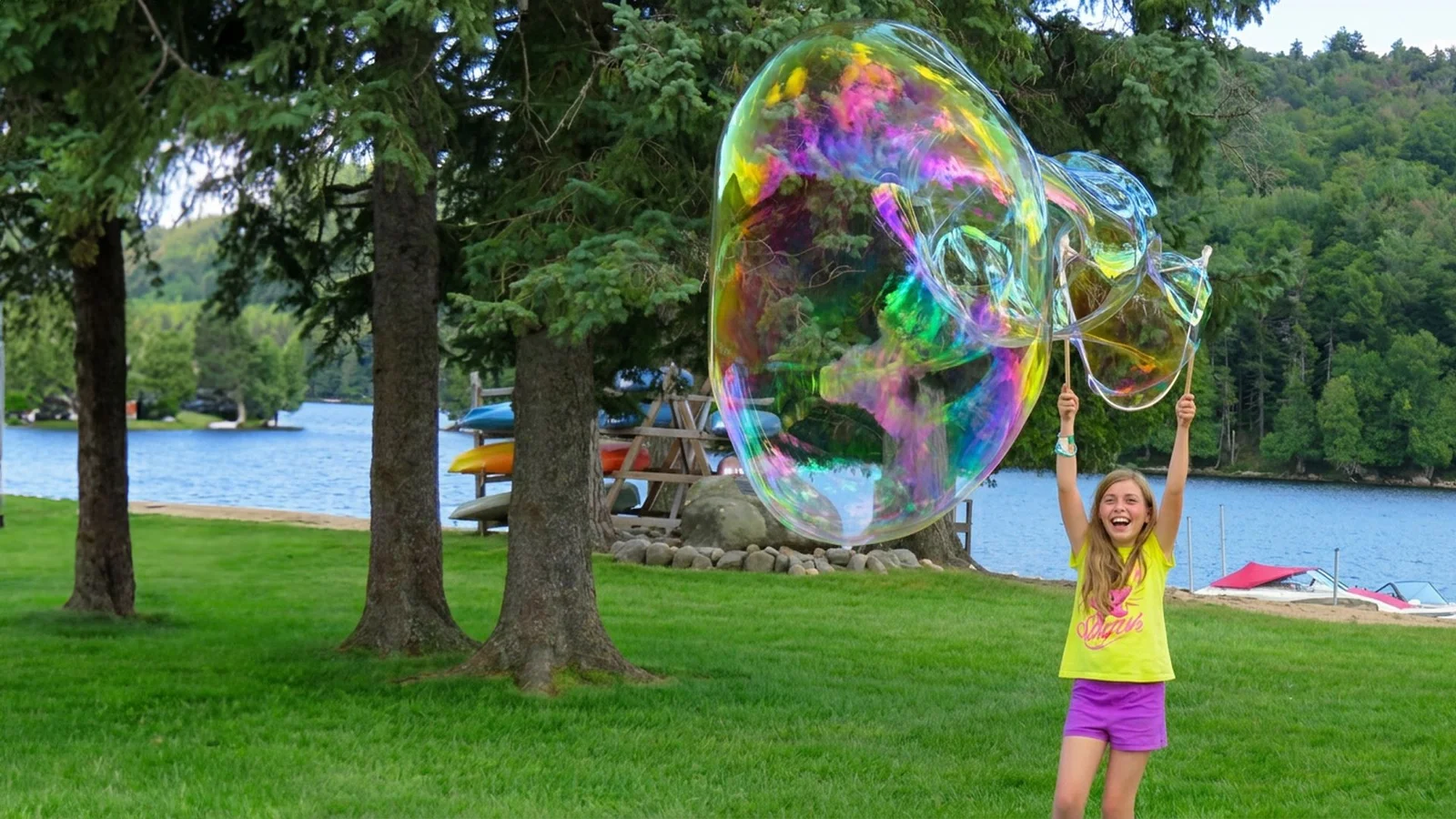
It also explains the shapes. Still attached to the wand, the film is held at one end and pushed at the other, so it becomes tubes, ribbons and long wobbling sausages. Close the ropes and surface tension rounds it up as it separates. Our giant bubble kit is designed to create bubbles over 20 feet long in favorable conditions.
Why Bubbles Have Rainbow Colors
There's no pigment in a bubble. Light reflects off both the outer and inner surfaces of the film; those two reflections travel slightly different distances and interfere, reinforcing some wavelengths and cancelling others. Which colors you see depends on the film's thickness at that exact spot, and because the film is constantly draining, the colors swirl in real time. When a patch goes nearly colorless or black, the film there is extremely thin — that bubble is seconds from popping.
How to Make Giant Bubbles: The Practical Sequence
This is what we do at every event:
- Mix the formula exactly according to the package instructions.
- Stand with the wind at your back.
- Dip the BubbleStix® sticks into the solution while closed.
- Lift them out closed and let them drip for about 2–3 seconds.
- Raise the sticks while they are still closed.
- Once they're high, open them wide and catch the wind.
- If there isn't enough wind, walk slowly backward.
- Once the bubble is moving gently, slowly close the ropes so it rounds up, separates and floats away.
- If the ropes tangle, point the sticks downward to straighten them.
Once mixed, BubbleStix® formula lasts approximately 2–3 days. For a fuller walkthrough of giant bubble techniques, start there.
Best Conditions for Giant Bubbles
| Condition | Favorable guideline | Why it helps |
|---|---|---|
| Humidity | Over 30% | Slows evaporation from the bubble film |
| Wind | Under 12 mph | Enough airflow to shape and carry the bubble without tearing it |
| Temperature | Moderate, ideally shaded | Hot, dry sun pulls water out of the film quickly |
These are practical BubbleStix® guidelines, not guarantees — performance depends on solution, wand, weather and technique together.
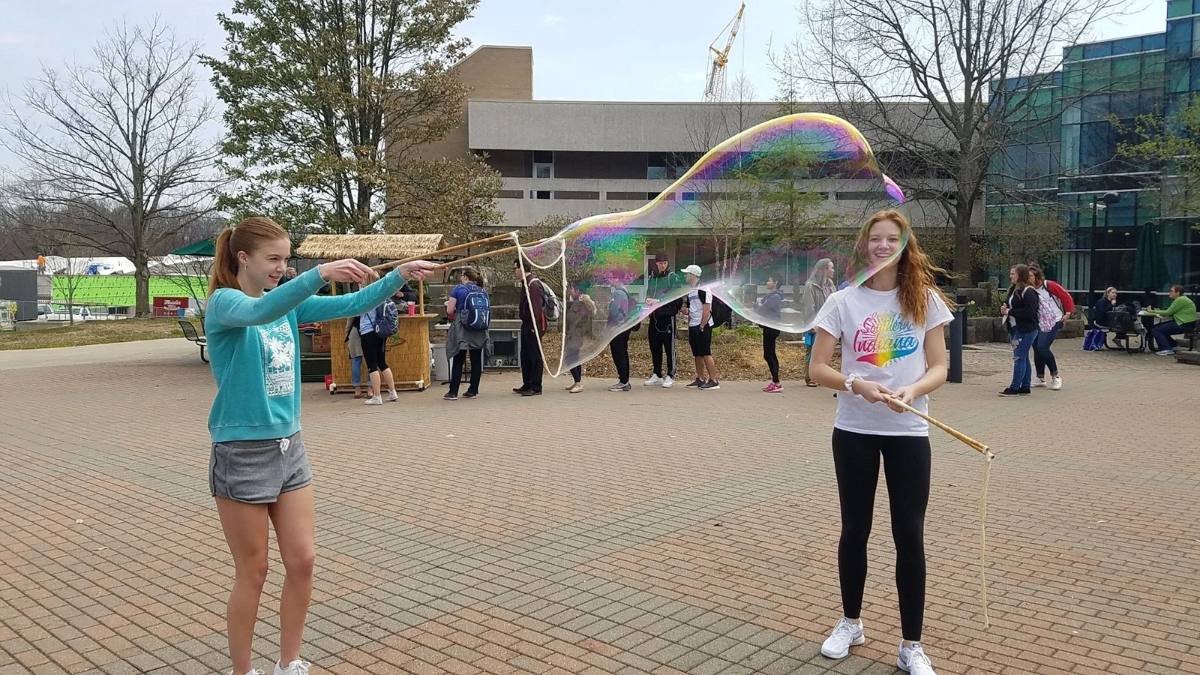
Moving air, not lung power, is what stretches the film into a giant bubble.
Put the Science to Work
The wand, the formula and the weather all pull in the same direction when you get them right.
Keep learning in Bubble Academy.